Most people choose a suit by its label and its price. A tailor looks at something else: how it sits on the body and how it was made. You can learn to check both in ten minutes, and you will choose better than most.
Start with the shoulders
The shoulder seam should end where your shoulder ends. If it hangs past the edge, the jacket is too big, and if it digs into your arm, it is too small. This is the one part of a jacket that is very hard to alter, so get it right first. Almost everything else can be adjusted.
Check the rest of the jacket
- Collar: it should lie flat against your shirt collar with no gap at the back of your neck.
- Sleeves: about a centimetre or a little more of shirt cuff should show.
- Length: the jacket should cover your seat and not ride up when you move.
- Waist: button it. If the fabric pulls into an X shape around the button, it is too tight.
Understand the cloth
Wool is the sensible choice. You will see numbers such as Super 100s or Super 120s. They describe how fine the yarn is. A higher number feels softer and finer, but it is usually less hard-wearing, so a middle range suits a suit you will wear often. In warm cities, look for lighter wool, often sold as tropical or all-season weight.
Feel the construction
Inside the jacket front there is a layer that gives it shape. In a fused jacket it is glued to the cloth. In a half-canvas or full-canvas jacket it is stitched in, and it moulds to your body over time. Pinch the front of the jacket between your fingers. If you can feel two separate layers that move a little, it is canvassed. If it feels like one stiff sheet, it is fused. Fused suits cost less, but they can look rippled after years of cleaning.
Look at the small details
On a striped or checked suit, the pattern should line up across the seams and at the pockets. Buttons should be sewn firmly. The lining should be smooth, with no pulling. These small things show how much care went into the whole.
Know your three options
- Ready-to-wear: made in standard sizes. Budget a small amount for alterations.
- Made-to-measure: a standard pattern adjusted to your measurements. A good middle path.
- Bespoke: a pattern cut for you alone, with several fittings. It takes the longest and costs the most.
Your first suit
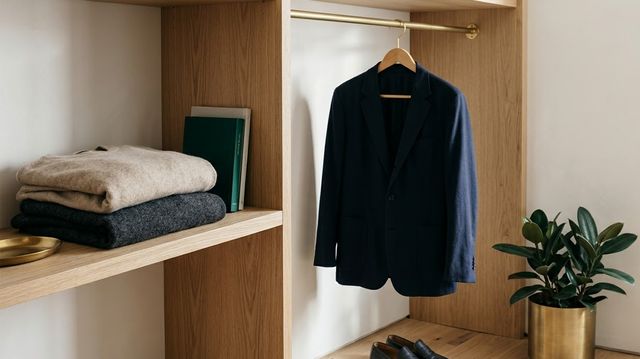
Buy a plain navy or charcoal suit with no loud pattern. You can wear it to a wedding, a board meeting and a funeral, and it will not date.
Three questions before you pay
- Do the shoulders fit without any tugging?
- Do I know what alterations it needs and what they cost?
- Would I wear this on an ordinary Tuesday?
A suit that fits well makes you look prepared before you say a word.